Melanin in our eyelashes and eyebrows does more than give colour. It protects the hair from sun damage and keeps them healthy. Recent research shows how pigment chemistry contributes not only to eyelash colour and eyebrow colour, but also to the strength, structure, and natural defences of these protective hairs.

All hair owes its colour to two core pigments:
Eumelanin gives rise to black and brown tones.
Pheomelanin which give red and golden colour to hair.
The ratio between these two and the amount of each determines the final hue:
▪️High eumelanin and low pheomelanin create black hairs.
▪️Moderate eumelanin produces dark brown.
▪️Low levels of eumelanin, often with a little pheomelanin give rise to blonde tones.
▪️Auburn hair has moderate amounts of both.
▪️Red hair has levels of eumelanin similar to blond hair, but also high levels of pheomelanin.
▪️Grey hair is due to reduced levels of melanin and white hair is a complete lack of melanin.
Recent work by Fernandes et al. (2023) and Menichetti et al. (2024) shows that small genetic changes in melanin biosynthesis can shift this balance, explaining why brow and lash colour sometimes differ slightly from scalp hair.


Melanin is a potent photoprotective barrier built in to hair, helping to protect the delicate structure of the hair from sun damage. Eumelanin efficiently absorbs ultraviolet radiation and dissipates it as harmless heat, reducing UV damage to the keratin that makes up the bulk of the hair body. This is the same process that fades fabrics or paint that are exposed to the sun for a long time.
Pheomelanin provides less protection and can generate reactive oxygen species under UV exposure, meaning that red or blonde hair is more susceptible to fading and brittleness from the sun.
Unlike skin, hair is dead tissue once it leaves the follicle as it contains no living cells and therefore cannot regenerate pigment. When ultraviolet light from sunlight strikes the hair, it oxidises a little of the melanin molecules. This chemical change disrupts the structure of melanin and reduces its intensity of colour. The altered pigment molecules absorb less visible light, so the hair appears lighter or “bleached.” When you apply lemon juice to hair in the sun, it lowers the local pH which acts chemically to degrade the melanin and the combination speeds up the process.
Eyelash and eyebrow hair often appear a slightly different shade than the hair on our head. An older study from 1995 by Irmak et al found that melanin is distributed differently in scalp hair compared to lashes and brows. It is thought that the difference in colour comes from this difference in distribution, as well as the structural difference of the hair, but more research is required to know for sure.
Another interesting difference between eyelash and eyebrow hairs compared to hairs from the scalp is related to greying. Scalp hairs tend to go grey earlier, and many people find that eyelashes do not go grey until a very advanced age. White hairs are also rare in both eyelashes and eyebrows, and more commonly appear as a single white hair. It is thought that this is due to the expression of different genes relating to melanin in the lash and brow follicles leading to more melanin producing cells in their follicles.
There can be situations where grey hair is brought on by medication such as chemotherapy drugs. A 2024 review by Pérez et al. listed medications can have been shown to occasionally cause changes to the colour of hair, including lashes and brows.
Beyond filtering light, melanin serves as a biological antioxidant. It neutralises free radicals generated by sunlight, pollution, or chemical exposure, preventing oxidative stress within the hair shaft. Melanin as a “redox buffer” which means that it stabilise reactive species like free radicals. This protects structural proteins and the surrounding follicle tissue, helping preserve both pigment and mechanical strength of the hair as well as the integrity of the follicle. Experimental work by Herrling et al. (2008) confirms that eumelanin is a potent antioxidant in both the skin and hair.
Even without exposure to UV light or high levels of air pollution, melanin itself will oxidise over time. Once it has degraded there is a decline in colour intensity and the reduced anti-oxidant protection causes the hair to become more fragile. This is why an antioxidant-enriched lash and brow serum is vital for maintaining both colour and condition.
If you have ever had your eyelashes or eyebrows tinted then you will know how effective it can be. The mechanism for the tint depends on the modification of melanin.
The first step is to apply an alkaline solution, often ammonia or an equivalent base, to lift up the cuticles. It does this by swelling the hair and breaking down the fatty acid later the surrounds the hair. This makes the hair more porous so dyes can penetrate easier.
The second step is to apply a peroxide. This overwhelms the melanin with free radicals, causing the melanin to oxidise and degrade. This turns the melanin pale and also damages some of the surrounding keratin. This is a sped up version of how sunlight or pollution damages hair.
Dyes, which are often in the same liquid as the ammonia, slowly react with each other and join together into large granules that are within the hair. The oxidisation that is happening facilitates this process but it takes time for the full reaction to occur, which is why you need to give the tint time to develop. When developed, the dye molecules that have joined together will now be too large to exit out from the hair.
At the end, a slightly acidic conditioning agent is applied to the hair. This neutralises any remaining peroxide and encourages the follicles to return to a smooth position.

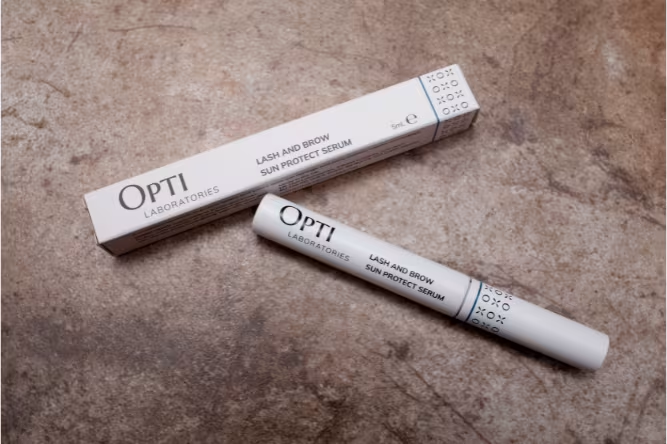
The dye used are usually often last for weeks but they are not as stable as the bodies natural melanin. The original melanin of an existing hair will not return and the colour of the tint will fade with time as UV light degrades the dye by breaking it back down to its smaller component parts. We believe that our Sun Protect Serum prolongs the lifespan of a tint by protecting the tinted hair from UV rays, slowing down the break up of the dye. Our own research has shown the value of UV protection for the lashes and brows.
Melanin defines far more than colour. In eyelashes and eyebrows it provides photoprotection, and antioxidant defence. Eumelanin is naturally darker and more resistant to UV, while pheomelanin gives red tones to hair but with lower resilience. Knowing the science of melanin is important for tinting of lashes and brows, and for developing better products to protect our hair. Maintaining darker eyelashes and darker eyebrows means preserving melanin through antioxidant care and UV protection, and by doing this you will have healthier hairs that can grow longer.
Reference:
Commo, S., Wakamatsu, K., Lozano, I. et al. (2012) ‘Age-dependent changes in eumelanin composition in hairs of various origins’, International Journal of Cosmetic Science, 34(1), pp. 102–107.
Available at: https://www.researchgate.net/publication/51739631_Age-dependent_changes_in_eumelanin_composition_in_hairs_of_various_origins
Fernandes, B., Cavaco-Paulo, A. and Matamá, T. (2023) ‘A comprehensive review of mammalian pigmentation: Paving the way for innovative hair colour-changing cosmetics’, Biology, 12(2), 290.
Available at: https://www.mdpi.com/2079-7737/12/2/290
Lademann, J., Patzelt, A. and Darvin, M.E. (2020) ‘The effects of environmental pollutants and oxidative stress on hair and scalp’, Skin Appendage Disorders, 6(4), pp. 262–272.
Available at: https://karger.com/sad/article/10/4/262/902859/The-Effects-of-Environmental-Pollutants-and
Menichetti, A. et al. (2024) ‘Melanin for Photoprotection and Hair Coloration in the Emerging Era of Nanocosmetics’, Cosmetics, 11(1), 9.
Available at: https://pmc.ncbi.nlm.nih.gov/articles/PMC11172709/
Zhang, Q., Li, X. and Zhou, J. (2014) ‘Human eyelash characterization’, Journal of Cosmetic Science, 65(5), pp. 297–304.
Available at: https://www.researchgate.net/publication/26870800_Human_eyelash_characterization
Pérez, S.M. et al. (2024) ‘Drug-induced hair pigmentation: clinical perspectives and mechanisms’, Journal of Dermatological Research and Venereology.
Available at: https://colab.ws/articles/10.1016%2Fj.jdrv.2024.11.009
JAAD Case Reports (2025) ‘Poliosis as a result of temporary eyelash tinting’.
Available at: https://www.jaadcasereports.org/article/S2352-5126(25)00199-7/fulltext
Herrling, T., Jung, K. and Fuchs, J. (2008) ‘The role of melanin as protector against free radicals in skin and its role as free radical indicator in hair’, Journal of Photochemistry and Photobiology B: Biology, 90(2), pp. 135–144.
Available at: https://www.sciencedirect.com/science/article/abs/pii/S1386142507005525
Nogueira, A.C.S. and Joekes, I. (2011) ‘Photodamage determination of human hair’, Journal of Photochemistry and Photobiology B: Biology, 103(2), pp. 93–99.
Available at: https://www.sciencedirect.com/science/article/abs/pii/S1011134412002072
Mariano, A. et al. (2021) ‘Pheomelanin effect on UVB radiation-induced oxidation and phototoxicity’, International Journal of Molecular Sciences, 23(1), 267.
Available at: https://www.mdpi.com/1422-0067/23/1/267
Ządło, A. et al. (2019) ‘Photobleaching of pheomelanin increases its phototoxic potential’, Photochemical and Photobiological Sciences, 18(11), pp. 2873–2883.
Available at: https://pubmed.ncbi.nlm.nih.gov/30457208/
Irmak, M. K., Dalcik, H., & Özcan, O. (1995). Distribution of melanosomes in different hair types. Turkiye Klinikleri Journal of Medical Sciences, 13(2), 47–49.
Abstract / PDF: https://www.researchgate.net/publication/348355406_Distribution_of_melanosomes_in_different_hair_types