Understanding the Eyelash Growth Cycle and Eyebrow Growth Cycle

Opti Laboratories was established by experts in eyelash and eyebrow growth. By understanding the eyelash growth cycle, as well as the eyebrow growth cycle, we have designed treatments that have helped 10’s of thousands of people to maximise the health and appearance of their lashes and brows. We have helped clients from many backgrounds from around the world – some with specific problems that required our expertise and experience, but many that simply wanted the best eyelash growth they could get. Underlying all of this is consideration and understanding of the hair growth cycle.

The Phases of the Hair Growth Cycle

All human hair follicles, wherever they are on the body, complete a cycle through four key phases:

1. Anagen is the growth phase.

2. Catagen is the transition phase, when growth is stopping.

3. Telogen is the resting phase and the longest part of the cycle.

4. Exogen is when the hair is shed and a new cycle begins.

Cycle Length differences between Scalp, Eyelash and Eyebrow hair

Cycle length

Scalp hair has a long anagen stage which is often measured in years. Some studies suggest a range of 2 to 6 years for most of the population but it may be as long as 10 years in certain people. This allows scalp hair to grow far longer than the eyelashes and eyebrows. Research has shown that  lashes and brows have much shorter growth cycles that are mostly commonly measured in months. (months or weeks) so they stay much shorter. 

The precise length of both the eyelash and eyebrow growth cycle has been reported from as short as 90 days to as long as 11 and a half months.

GROWTH

If you could record the growth of a single hair over a period of months then you would see that growth is not uniform or continual. Instead, it grows during the anagen stage then spends the majority of its time in a steady state without any further growth. It is thought that between 80 – 90% of scalp hairs are in the anagen phase, although eyelashes and eyebrows were found to be as low as 17.8% but not any higher than 41%.

When they are growing it has been found that scalp hair typically grows around 0.3 to 0.4 mm per day meaning that only 1 cm of hair is added each month. The rate for the eyebrow growth cycle is not as well studied but are thought to be similar to scalp hair, whereas the rate for lash growth is significantly shorter at 0.12 mm per day. 

The combination of a shorter period spent in the anagen phase with a slower growth rate reminds us that only a portion of our eyelashes are growing at the same time, whereas on our scalp almost all of our hairs are.

Detailed comparison of scalp, eyelash and eyebrow hair

CharacteristicScalp HairEyelash HairEyebrow Hair
Primary FunctionThermal regulation, protectionOcular protection (barrier against dust, light)Expression & eye protection
Follicle TypeTerminalTerminal but without an arrector pili muscleTerminal, smaller curved bulb compared to scalp
Anagen (Growth Phase)2 to 6 years1 to 2 months (some Studies suggest between 3 weeks and 3 months)4 to 8 weeks
Catagen (Transition Phase)2 to 3 weeks 2 to 3 weeks2 to 3 weeks
Telogen (Resting Phase)3 to 6 months2 to 3 months (with some studies going as high as 9 months)2 to 3 months
Total Cycle Length (average)2 to 8 years4 months3 to 4 months
Growth Rate0.3 – 0.4 mm/day0.12 mm/day0.30 mm/day
Average Natural LengthUp to 100 cm (uncut)7 to 12 mm5 to 11 mm
Number of Follicles~100 000 per scalp (highest in blondes, lowest for redheads)90 to 160 per upper eyelid in 5 or 6 rows, and 75 to 80 per lower eyelid in 3 or 4 rows400 to 600 per brow
Density per cm²250 – 30090 to 120 for the upper eyeline and 50 to 60 for the lower200 to 300
Synchrony of CycleHighly asynchronous with 10% in telogenAsynchronous with the majority restingModerately synchronous
Hormonal SensitivityStrongly sensitive to androgensMinimal androgen sensitivityMildly sensitive to androgens but sensitive to thyroid status
PigmentVaried by individualmore eumelanin and denser levelsDenser than scalp
Follicle depthDeepshallowModerate
Typical Shedding per Day50 to 100 hairs1 to 5 lashes2 to 3 brow hairs
Response to Prostaglanin Analogues (e.g., Bimatoprost)MinimalStrong (prolongs anagen)Strong (prolongs anagen)


Factors that slow or block the growth cycle

Understanding what disrupts or slows the lash or brow growth cycle can hep us to take steps to avoid, where possible, detracting factors.

AGEING

As we age our hair follicles undergo changes too. The anagen phase shortens, the follicle decreases in size and the stem cells that are found at the base of the follicle decline – sometimes to the point of exhaustion. 

HORMONAL CHANGES

Hormonal levels have broad, system wide effects. For example, a menopausal drop in oestrogen levels impairs Wnt/β-catenin signalling in hair follicles which will impact brow & lash growth too. Thyroid levels are also important for hair growth, with low levels having the particular effect of eyebrow thinning. That is why the use of thyroxine can help recover hair loss if there have been thyroid issues.

AUTOIMMUNE DISEASE

In the context of alopecia areata, involvement of lashes or brows often signals a more severe case.

Over plucking or tweezing, or trauma 

Repeated trauma can cause follicles to prematurely exit anagen or even become dormant. This is most commonly from plucking the brows but can also be from force. For example, we have had a client that had a football hit their face and this resulted in a partial shed of their eyebrows and eyelashes on the one side.

Eyelash extensions and tinting

These increase mechanical stress on the follicle which is termed tension or traction alopecia if it begins to slow down or stop the growth cycle. The chemicals employed often chemically damage the hair, releasing free radicals into the body of the hair that can damage the keratin.

Chronic blepharitis, rosacea or eczema

For lashes and brows, anything that causes inflammation at the follicle base can cause growth cycle disruption.

Nutritional deficiency, high stress levels or systemic illness

Generalised hair-cycle slowing (including brows/lashes) happens in telogen effluvium scenarios when the body is under a lot of stress. A nutritional deficiency will also limit the growth cycle if it can not call upon the resources necessary to fully grow.

Medications 

Some treatments negatively impact follicle cycling such as retinoids, chemotherapy, blood pressure medication and anti-depressants.

SUN DAMAGE

UV radiation can prematurely induce catagen (transition phase), damage the follicle stem-cell supply, cause oxidative damage to keratin in the hair, and shorten the anagen growth phase. The hair follicles of eyebrows and eyelashes are not as deep as they are on other parts of the body so the damaging UV rays can reach the follicle easier.

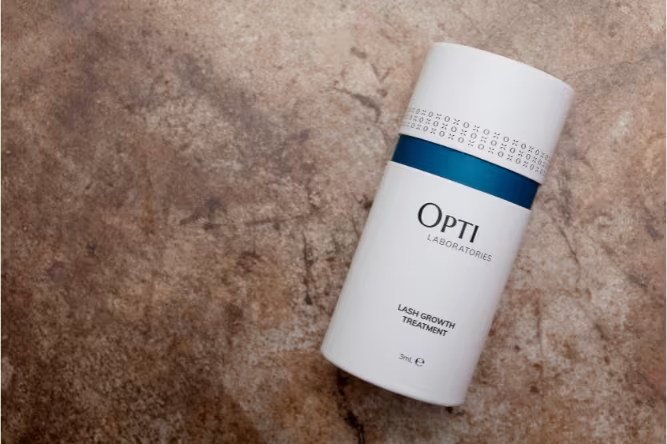
Opti Laboratories Lash Growth Treatment

Growth treatment

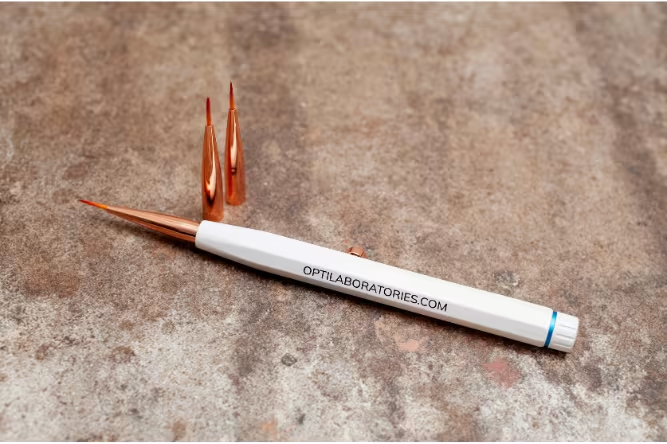
Slide brush for treatment and bundle

ULTIMATE PRODUCT BUNDLES

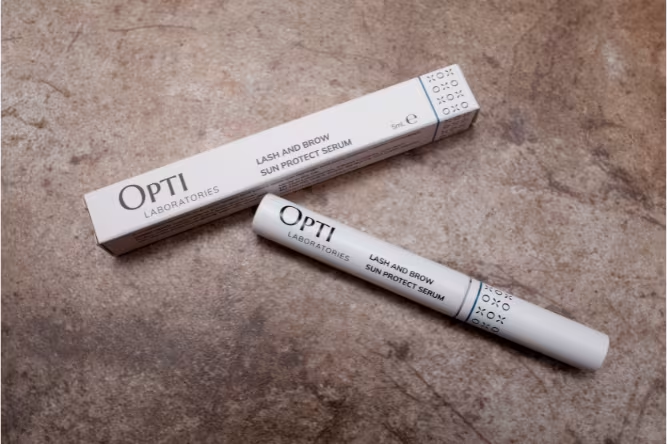
Opti Laboratories Sun Protect Serum

SUN PROTECT SERUM

The UK experts in lash and brow care with 18 years experience

Find out more about our clinically proven, innovative solutions

Reference:

Munro D. Disorders affecting the skin appendages. In: Dermatology in General Medicine (Fitzpatrick TB, ed.). New York: McGraw-Hill, 1971; 299

Thibaut S, De Becker E, Caisey L, Baras D, Karatas S, Jammayrac O, Pisella PJ, Bernard BA. Human eyelash characterization. Br J Dermatol. 2010 Feb;162(2):304-10. doi:10.1111/j.1365-2133.2009.09487.x. PMID: 19804590.
Link: https://pubmed.ncbi.nlm.nih.gov/19804590/

Cooper, G. A. A. (2015) Chapter 1 – Anatomy and Physiology of Hair, and Principles for its Collection. In P. Kintz, A. Salomone & M. Vincenti (Eds.), Hair Analysis in Clinical and Forensic Toxicology (pp. 1–22). Boston: Academic Press. ISBN 978-0-12-801700-5. Link: https://www.sciencedirect.com/science/article/pii/B9780128017005000017

Starace M, et al. “Impact and Management of Loss of Eyebrows and Eyelashes.” Dermatologic Therapy. 2023. PMC full-text: https://www.ncbi.nlm.nih.gov/pmc/articles/PMC10264316/

Cuevas-Diaz Duran R, Martinez-Ledesma E, Garcia-Garcia M, et al. “The Biology and Genomics of Human Hair Follicles: A Focus on Androgenetic Alopecia.” Int. J. Mol. Sci. 2024; 25(5):2542. https://doi.org/10.3390/ijms25052542

Gupta A.K., Economopoulos V., Mann A., Wang T., Mirmirani P. Menopause and hair loss in women: Exploring the hormonal transition. Maturitas. 2025;198:48-55. doi:10.1016/j.maturitas.2025.01.XXXX. Available at: https://www.sciencedirect.com/science/article/pii/S0378512225001860

Mostaghimi A, Craiglow B, King B, Shapiro J, Ko J, Tosti A, Ohyama M, Brogan Y, Yu G, Sontag A, Somani N. Understanding eyebrow and eyelash involvement in patients with alopecia areata and responsiveness to treatment with baricitinib. Br J Dermatol. 2025 Jul 17;193(2):240-249. doi:10.1093/bjd/ljaf088. PMID: 40179237.
Link: https://pubmed.ncbi.nlm.nih.gov/40179237/