
Chemotherapy causes eyebrow loss by targeting rapidly dividing cells throughout the body, including those within hair follicles. Eyebrow follicles divide quickly enough to be affected by this mechanism, making brow loss one of the most common and visible side effects of treatment.
The majority of patients undergoing chemotherapy experience partial or complete eyebrow loss, with some studies reporting 89% and 32% respectively. The extent depends on the drug class, dosage, and duration of treatment.
Loss typically begins within the first few weeks after chemotherapy starts. For some patients it is gradual; for others it is rapid. Importantly, this is a direct biological effect of the treatment itself and it is not something that can be prevented by topical products during active chemotherapy.
| Drug class | Likelihood of brow/lash loss |
|---|---|
| Taxanes (e.g. docetaxel) | High and often complete |
| Anthracyclines (e.g. doxorubicin) | High |
| Alkylating agents (e.g. cyclophosphamide) | Moderate to high |
| Targeted therapies (e.g. EGFR inhibitors) | Variable |
| Hormone therapies (e.g. tamoxifen) | Low to moderate |
Understanding the drug class helps set realistic expectations for recovery once treatment ends.

Eyebrows have a relatively short anagen phase (the active growth period) typically around 4 to 8 weeks.
This shorter growth phase means each brow hair has limited time to grow before it naturally sheds. After chemotherapy, follicles often restart from a disrupted baseline, producing finer, patchier regrowth initially.
Most patients begin to see some regrowth within 3 to 6 months after treatment ends. However, full density can take longer, particularly in patients who continue with hormone therapies.
The follicles themselves are rarely permanently destroyed. Instead, their growth cycle is disrupted. The focus of treatment is therefore to help re-establish a stable and prolonged growth phase.
For a detailed overview, see our guide on regrowing eyelashes and eyebrows after chemotherapy.

Most brow serums are cosmetic products. They condition existing hairs and improve appearance, but they do not alter the follicle or change the growth cycle.
Pharmaceutical grade brow growth treatments act at the follicle level. They help prolong the anagen phase, allowing each hair to grow for longer before shedding.
This difference is fundamental. Conditioning improves what is already there. Growth treatment changes what the follicle produces.
The Opti Laboratories Brow Growth Treatment is a doctor-led formulation designed for this purpose. Clinical data demonstrates:
25% increase in length
106% increase in thickness
18% increase in colour density
These are measured outcomes over a 16-week period, reflecting changes in follicle activity rather than surface conditioning.
| Product type | Mechanism | Extends growth phase | Evidence level |
|---|---|---|---|
| Cosmetic serum | Conditions hair shaft | No | Limited |
| Natural oils | Moisturising | No | None |
| Growth treatment | Follicle-level activity | Yes | Clinical data |
If cosmetic serums have not worked for you after chemotherapy, the mechanism is usually the reason and not the follicles themselves.


“After five months of chemotherapy to blitz my ovarian cancer, I had no body hair left, as chemo kills the cells that produce hair follicles. Losing the hair on my head I could deal with even though I’d always had long hair. My boyfriend Mark shaved my head and I simply carried on with the same determination that had seen me through the intense nausea, fatigue and hot flushes of chemo. But without eyelashes and brows I found my face had no definition. My reflection was blank: I looked like a boiled egg.
In June, my hair grew back as thick as ever. My leg hair, too, came back with a vengeance. But my lashes were so short and frail they were all but invisible. No mascara in the world could help. Desperate to feel feminine again after having extensive surgery, I turned to Grazias beauty team, who recommended I visit lash extension expert Sue Marsh at her London clinic. It took two hours to apply around 200 false lashes and, when I walked out, I felt attractive for the first time since I’d been ill. I even caught my reflection in a shop window and was pleasantly surprised.
I would happily have spent £190 on eyelash extensions every three months for the rest of my life, but Sue warned me that relying on extensions full-time meant my eyelashes would never recover their full natural length. So, Sue sent me to MyLash (now part of the Opti Laboratories family). MyLash provides consultation and treatment for individuals that wish to activate and enhance their natural lash growth.
After a consultation, it was agreed that MyLash could help me. I painted a solution that was prescribed to me on like eyeliner every night and after six weeks my eyelashes were 25 percent longer. Within three months they were 100 per cent thicker and felt fabulously full. Best of all, they looked better than they did before I was ill. For an extra boost, Sue gave me a lash lift — an eyelash curl that lasts eight weeks.
The result looked natural, only better. Without being able to pinpoint exactly what’s changed about me, friends tell me I’ve got the twinkle back in my eye. And when I see my new eyelashes in the mirror, I finally look like me again.
Written by:
Becky Gee
Beauty editor, Grazia Magazine.
Timing is important. Starting treatment during active chemotherapy is not recommended, as the follicle environment is still suppressed.
The appropriate time to begin is a few weeks after treatment has finished, but individual circumstances vary and we can advise on this.
Once started, consistency matters. Most patients see early signs of regrowth at 6 weeks, with more visible improvement at 16 weeks.
This reflects the natural growth cycle. There is no way to bypass this biology, only to support it effectively.
We have helped thousands of people regrow their eyebrows and eyelashes after chemotherapy. It is a difficult journey but we are ready to help you.
Once any underlying medical or nutritional cause has been addressed, many people want to regrow their lashes and eyebrows.
Opti Laboratories are the eyelash and eyebrow growth experts. We believe that night time behaviours are under-recognised and that simple interventions can make a measurable difference.
Our clients include individuals recovering after:
▪️Thyroid related brow loss
▪️Chemotherapy related eyelash thinning
▪️Trichotillomania and related issues
▪️Cosmetic over plucking
▪️Eyelash and eyebrow loss from radiotherapy
▪️Thinning eyelashes due to medications
However, we also help a lot of people that simply want longer eyelashes and thicker eyebrows too.
Based in the UK and led by a team of British doctors, we have helped thousands of clients. since 2007 and we have been recognised in UK newspapers and magazines.
We continue to innovate. Our award-winning daytime lash and brow serum, the first in the world to offer UV protection for lashes and brows, supports growth and helps protect fragile follicles during your recovery.
This article is intended for educational purposes and does not replace individual medical assessment. Persistent or unexplained eyelash or eyebrow loss should be evaluated by a qualified healthcare professional.


The growth treatment and the sun protect serum
£169.00

The ONLY clinically-proven growth treatment. Also available for brows.
£120.00 (3 month supply)
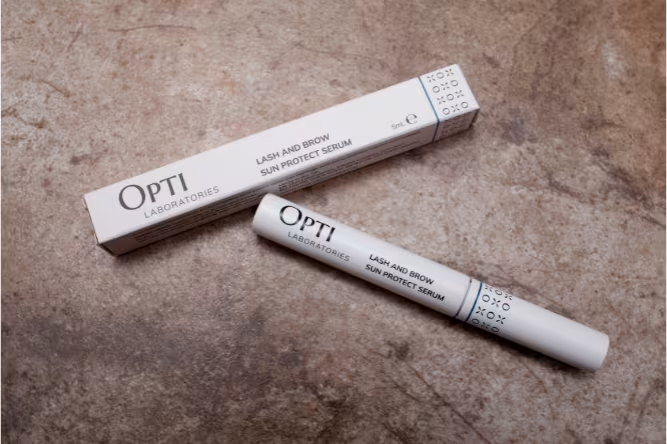
The world’s first lash and brow serum to protect from sun damage.
£59.00
Yes. Chemotherapy targets rapidly dividing cells, including those in hair follicles. This commonly leads to partial or complete eyebrow loss during treatment.
Eyebrow loss usually begins 2 to 4 weeks after starting chemotherapy, though timing varies depending on the drugs used and the individual response.
In most cases, yes. Eyebrows typically begin to regrow within 3 to 6 months after treatment ends, although full density can take longer.
Eyebrows have a short growth phase. After chemotherapy, follicles take time to re-enter the growth cycle, leading to slower and sometimes patchy regrowth.
Cosmetic serums can improve the condition of existing hairs, but they do not stimulate new growth. Treatments that act at the follicle level are required for measurable regrowth.
A few weeks after completing chemotherapy. Starting too early may be ineffective or inappropriate.
Early changes may appear after 6 to 8 weeks, with more significant results typically visible at around 16 weeks, in line with the natural growth cycle.
In most cases it is not permanent. The follicles are usually still present but temporarily disrupted. With time, and in some cases treatment, regrowth can occur.