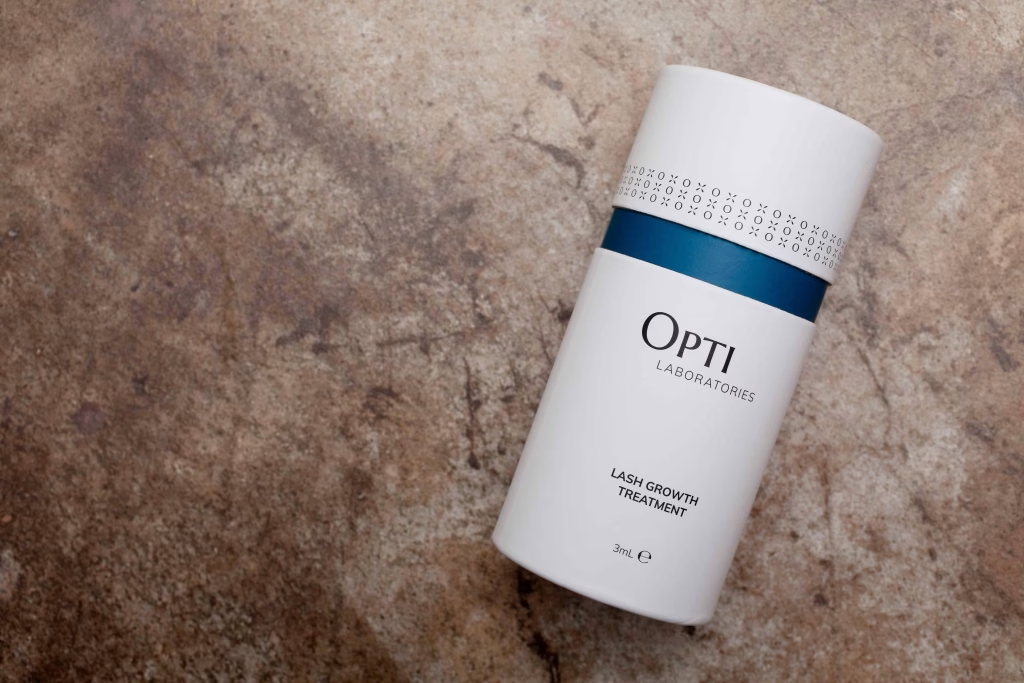
What is Opti Laboratories Growth Treatment?
The Opti Laboratories Growth Treatment is the same 0.3 mg/ml (0.03%) solution of bimatoprost, previously marketed as the Mylash Growth Treatment and, in the US, as Latisse. It is a clinically proven solution with a wealth of scientific research to demonstrate its efficacy. It has been approved for cosmetic use by the FDA in a trial that demonstrated daily application to result in lashes that are 25% longer, 106% thicker and 18% longer.
The treatment is now available with more robust packaging, designed to support your use of the treatment, and with softer, reusable application brushes. If you’re an existing Mylash customer and would prefer to continue with the disposable brushes, however, we will be happy to provide them.
Why has the applicator changed?
We’ve listened to customer feedback and have designed an applicator which is easier to hold and use, softer on the delicate eye area and more precise in its application.
The retractable head protects the brush if you are travelling or during storage in your cosmetics bag. Your treatment comes with three washable brush breads, which can be re-used and replaced throughout your treatment.
The applicator replaces the single-use plastic applicators provided previously.

HOW DOES THE GROWTH TREATMENT WORK?
The Growth Treatment works because of its active ingredient, bimatoprost. Bimatoprost is a prostaglandin analogue, a synthetic version of a class of naturally occurring molecules. Prostaglandins are a bit like hormones – a signal that your body uses to regulate processes like hair growth.
Your lashes grow in a cycle with three phases:
Anagen (active growth phase)
Catagen (transition phase)
Telogen (resting phase)
The bimatoprost in the Growth Treatment mimics the body’s natural signals, extending the anagen phase of the lash’s growth. As a result, your eyelashes grow for a longer period of time, resulting in thicker, stronger, and longer lashes.
How was the growth treatment created?
The growth treatment derives from a medical glaucoma eye drop, sold under the brand name “Lumigan”. Patients using Lumigan for glaucoma, found that they grew longer, thicker and darker eyelashes than usual.
This is because the bimatoprost was soaking into the hair follicles closest to where it was applied (to the eye), and caused those hairs to enter their anagen, or growth, phase. The individual hairs grew thicker and longer than normal, and the increased thickness resulted in a darker appearance to each hair.
Lumigan was soon approved for use as an eyelash growth treatment. It has FDA approval, and the FDA’s clinical trials found that the eyelashes were on average 106% thicker, 25% longer and 18% darker after consistent use. Most users see results within 4 weeks but the best results take 16 weeks to appear. This is because the growth cycle for all of your eyelashes take 16 weeks on average to go through the growth phase.
Do eyelash "growth" serums work the same way?
The Growth Treatment is not the same as an eyelash serum.
Serums are designed to condition and nourish your lashes, but they don’t contain an active growth ingredient like bimatoprost, so they can’t actually grow your lashes.
Anything that contains an active growth ingredient will require a prescription, so be wary of claims that a product will grow your lashes if it’s available to buy without a medical form.
What are the possible side effects?
It is very rare to experience side effects using the Growth Treatment and, in our experience, if they do occur it is often due to incorrect application
In clinical trials, less than 2% of users experienced irritation or redness. Our customers experience side effects more rarely still, because our application technology is more precise than what was used in the clinical trial. Rare side effects include:
- darkening (brown) pigmentation of the coloured part of the eye (the iris) which may be permanent. This is more common when used for treating glaucoma.
- eyelid skin darkening, this can sometimes be permanent.
- hair growth in other areas that bimatoprost touches and not blotted away, such as the eyelids or face.
- thinning of the skin around the eye. This is called ‘orbital atrophy’ but is more common in the treatment of glaucoma.